This section contains articles that discuss the social process of turning truth-tellers, outsiders, heretics, witches, queer people, dissidents, rebels and demons into monsters.
12 Jun 2026 – The Rebel Question and the Comfort Machine – by El Amethyst
I am beginning with images from 30th April because that seemingly ordinary day was threaded with heavy emotional and shadow work, and the photographs held the pattern of this article in plain sight: shelter, signs, shadow, sea, and system.
shelter. signs. shadow. sea. system.
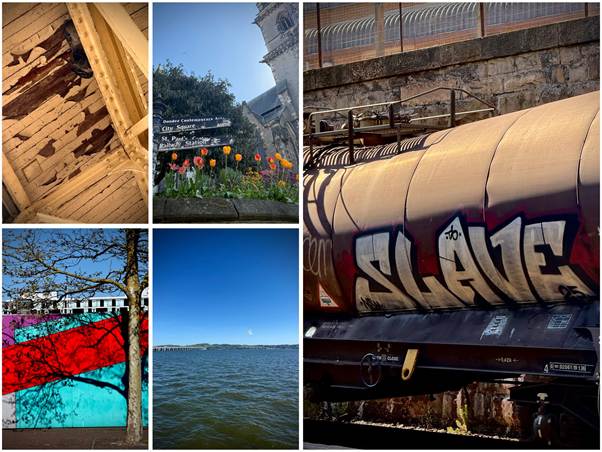
Some days do not arrive in discussion.
They come in fragments.
First shelter.
A bird tucked into damaged rafters. Old paint lifting from tired wood. A small body finding shelter inside a structure that is worn, neglected, and still somehow holding. I saw that first. Not as a pretty image, not as decay made aesthetic, but as survival choosing the hollow place and making it enough.
Then came the signs.
Weathered direction markers pointing through the city, flowers reaching upward beside old stone, colour and route and uncertainty sharing the same frame. There was something in that too. Something about finding direction while the heart is not entirely sure where it is standing. Something about beauty growing beside instruction, beside institution, beside routes other people named long before I arrived.
Then shadow.
Tree shadows cast across bright colour, branches crossing turquoise and red, darkness not erasing the surface but revealing it differently. That mattered. Shadow did not destroy the colour. It gave it depth. It interrupted the flatness. It made the image more honest.
Then the sea.
Water stretching further than thought, holding the sky, making room for everything too tangled to name. The sea did not ask me to explain myself before it received me. It simply moved, breathed, widened, carried.
And then the system.
A train carriage. Industrial steel. Movement, labour, function, machinery. Across it, in huge letters, the word SLAVE.
By the time the word SLAVE appeared on steel, the day had stopped being only symbolic and started being structural.
That image was not subtle. It did not whisper. It named the wound underneath the machinery. Shelter. Signs. Shadow. Sea. System. The sequence had become a map of the day, but also of something larger than the day.
This is how therapeutic photography speaks when I let it. Not as decoration. Not as proof. Not as “nice pictures.” As a way of seeing what the conscious mind has not yet finished saying.
This is where I choose to begin.
Not with theory or concepts, but with a seemingly ordinary day carrying the pattern in plain sight.
Before I go any further, it feels important to say who is speaking.
This matters because it shapes how this article is written, what it pays attention to, and the kinds of knowledge it draws upon. It is not written from a single discipline, a single identity, or a single way of understanding the world.
I am writing as a queer deeply spiritual sociologist, philosopher, survivor, therapeutic photographer, activist, and poetic writer. I am writing as someone who has studied social structures, questioned moral frameworks, lived through trauma, raised children, cared deeply, loved fiercely, survived family systems, built community, stood beside queer and trans people, and learned to trust the language of images, bodies, symbols, dreams, music, and spirit.
I am done separating those parts of myself so they can be more easily understood.
That separation is part of the problem.
Sociology is not separate from spirituality when the systems shaping everyday life also shape what people are allowed to believe, name, feel, desire, resist, or become. Philosophy is not separate from survival when ethical questions are not abstract puzzles but lived conflicts of duty, loyalty, truth, safety, and freedom. Photography is not separate from thought when an image can catch what language has not yet admitted. Poetry is not decoration when it has been a survival language. Activism is not separate from love when love without accountability becomes sentiment dressed up as care.
My best work happens when the whole of me is here.
Sociology gives me structure. Philosophy gives me the blade. Spirituality gives me flame. Survival gives me evidence. Photography gives me sight. Activism gives me direction. Poetry gives me breath.
So this is the voice entering the work. Not split. Not softened. Not pretending that only one kind of knowing counts.
Whole.
From that whole place, I want to begin with a simple philosophical hinge:
pleasure and pain
Jeremy Bentham’s utilitarianism begins from the idea that human beings are governed by pleasure and pain. In simple terms, we move towards what brings pleasure, relief, happiness, satisfaction, comfort, and away from what brings pain, distress, frustration, fear, embarrassment, or suffering. The principle of utility then asks whether an action increases or decreases happiness.
There is something recognisable in that. Of course, humans seek relief. Of course we turn towards warmth, softness, joy, pleasure, rest, safety, laughter, love. Of course we do not want needless suffering. I am not interested in pretending that pain is holy just because it hurts, or that struggle is automatically noble because someone survived it.
That would be cruel.
The problem is not that humans seek pleasure and avoid pain.
The problem is what capitalist culture does with that instinct.
Capitalism takes the human need for relief and turns it into a whole culture of shallow comfort. It tells us that discomfort is failure, that difficulty is danger, that challenge is attack, that anything which interrupts ease should be avoided, replaced, consumed over, medicated through, scrolled past, or thrown away.
This is where comfort becomes dangerous.
Pleasure is not the enemy. Rest is not the enemy. Joy is not the enemy. Erotic embodiment is not the enemy. Chosen comfort is not the enemy.
The problem is numbness being sold as freedom and relief being sold as liberation while the wound stays open!
I know this in my own body. Even the way I feel about being tattooed makes the point. Tattooing hurts, but I do not experience that pain as meaningless harm. I experience it as chosen threshold. As ritual. As permanence. As beauty cut into skin. As memory, symbol, self-authorship, and embodiment.
That matters because humans do not only seek comfort. We seek meaning. We seek transformation. We seek the kind of intensity that makes us feel more alive, not less.
Capitalism benefits when we lose the ability to tell the difference between needless harm and transformative discomfort.
Because if all discomfort becomes something to avoid, then truth becomes avoidable too.
I repeat! Because if all discomfort becomes something to avoid, then truth becomes avoidable too.
That is where capitalism becomes more than an economic system. It becomes a comfort machine.
When I say capitalism here, I am not only talking about an abstract economic arrangement, or about individual people buying things inside a system they did not choose. I am talking about capitalism as a structure of power! A system organised around profit, accumulation, ownership, extraction, and growth, and the people, institutions, corporations, and political forces that benefit from keeping that structure intact.
Capitalism does not only produce commodities. It produces habits, desires, fears, identities, escapes, and whole ways of relating to ourselves and each other. It teaches us what to want, what to avoid, what to upgrade, what to discard, what to hide, what to buy, and what to become ashamed of.
It does not simply sell objects.
It sells relief.
It sells distraction.
It sells identity.
It sells escape routes.
It sells rebellion as outfit.
It sells spirituality as decoation.
It sells healing as personal branding.
It takes the ache and offers a product. It takes exhaustion and offers a subscription. It takes loneliness and offers a feed. It takes spiritual hunger and offers pretty things with no depth. It takes rebellion and turns it into something to wear, brand, pose with, or consume.
This is everywhere in the rebel stories people love.
It is Star Wars on a T-shirt while the person wearing it rolls their eyes at protest. It is Hunger Games representation while fearing working-class rage. It is Avatar fandom while ignoring environmental and Indigenous struggles to protect ecosystems and sacred places. It is Barbie feminism as pink product while actual genuine feminist disruption is dismissed as troublesome, disruptive, or going too far. It is V for Vendetta masks being sold by the very machine the story critiques. It is the Lucifer series turning the devil into a beloved, wounded, truth-telling rebel while, at the same time, people become uneasy around anyone who adopts Lucifer imagery or rebel ethos in real life, whether they are sincere, performative, misguided, charismatic, or simply unconventional. The fantasy rebel is adored! The living, breathing human who unsettles norms is far more likely to be treated as suspicious, dangerous, delusional, or morally suspect.
The system is happy to sell us rebellion as long as we do not practise it.
It wants the rebel as outfit, logo, film night, playlist, costume, collectible, slogan, pose, and vibe. It does not want the rebel as neighbour, worker, survivor, land defender, queer person, trans kid, organiser, whistleblower, artist, parent, friend, or community member saying ‘look at what is still happening’.
That is the trick.
Rebellion is allowed to be entertaining.
It is not allowed to become contagious.
Because once rebellion becomes contagious, it stops being a product and becomes a demand.
It stops asking, “How can I look different?”
It starts asking, “What has to change?”
And capitalism does not want that.
It does not want liberation.
Liberation would ask too many questions.
Who made this? Who paid the cost? Whose labour is hidden behind my convenience? Whose body absorbs the harm? Whose land was taken? Whose grief was made invisible? Whose silence makes my comfort possible?
Convenience is often outsourced consequence.
The comfort machine works because it keeps the wound managed but not healed. It offers just enough relief to keep people moving, producing, spending, scrolling, performing, and surviving inside the same conditions that are hurting them. It wants people regulated enough to keep functioning but not awake enough to challenge the system itself.
Capitalism sells relief from the wound while protecting the knife.
This is why shallow comfort is so politically useful. A person who is exhausted, distracted, ashamed, overstimulated, underpaid, overworked, and constantly offered quick relief is less likely to stop and ask what kind of world requires so much numbing in the first place.
Even care gets absorbed into the machine. Rest becomes a product. Healing becomes an individual project. Wellness becomes another market. Spirituality becomes a decorative shelf. Self-care becomes something to purchase instead of a wider question about why so many people are collapsing.
And disposability becomes normal.
We see it in fast fashion, planned obsolescence, single-use packaging, endless upgrades, algorithmic distraction, and the quiet training of attention away from repair. But a throwaway society does not stop at plastic. It teaches throwaway ethics.
It teaches us to throw away difficult conversations, uncomfortable truths, relationships that require repair, histories that implicate us, grief that takes too long, anger that will not behave, bodies that do not perform correctly, communities that ask for accountability, and parts of ourselves that refuse to stay convenient.
The comfort machine does not merely ask us to consume.
It teaches us to avoid becoming conscious.
Capitalism teaches us to avoid becoming conscious.
And when consciousness becomes dangerous, the system learns to mock it.
Capitalism and its allied systems do not only suppress rebellion through force. They also suppress it through ridicule. They turn dangerous words into jokes. They turn awareness into cringe. They turn compassion into weakness. They turn justice into hysteria. They turn structural analysis into overreaction. They turn rebellion into immaturity. They turn shadow work into self-indulgence. They turn embodied empowerment into threat.
They turn being awake into something embarrassing.
That is what has happened to the word “woke.” A word connected to awareness, especially awareness of injustice, racism, oppression, and systems of harm, has been twisted into an insult. It is spat out to make people sound ridiculous for caring, childish for noticing, extreme for naming what was already there.
That is not accidental.
Once a word becomes mockable, people hesitate to stand inside it.
That is useful to power. If awakening can be made embarrassing, fewer people will want to be seen as awake. If justice can be made cringe, fewer people will risk being associated with it. If structural analysis can be dismissed as overreaction, then people are pushed back into private discomfort instead of collective understanding.
The system turns awakening into embarrassment because embarrassment is cheaper than chains.
I know this pattern because “queer” has lived it too. Queer was used to wound, exclude, shame, mark, and sneer. Then queer people took it back. We made it shelter, fire, refusal, kinship, complexity, politics, beauty, erotic truth, and non-compliance. Reclaiming queer was never just about vocabulary. It was survival becoming speech.
“Woke” needs to be reclaimed! What a ridiculous idea, if you think about the language, to not want to be awake to structural harm and the impact on You.
That is why attacks on language matter.
Power knows that words can become doors. Words can let people find each other. Words can turn private shame into public recognition. Words can name the structure. Words can make the invisible visible. So when a word becomes too useful for liberation, the system tries to contaminate it. It turns the word into a joke, then waits for people to become too ashamed to use it.
This is why capitalism wants us avoiding rebellion, shadow work, embodied empowerment, and political awakening. Not because these things are silly, but because they are dangerous.
Rebellion threatens obedience.
Shadow work threatens false innocence.
Embodied empowerment threatens shame-based control.
Queer reclamation threatens fixed categories.
Awakening threatens the luxury of pretending not to know.
Capitalism wants us numb enough to consume, tired enough to comply, ashamed enough not to rebel, and fragmented enough not to recognise our own power.
So when “woke” becomes a slur, I hear the system confessing what it fears.
It fears people waking up!
Capitalism fears people waking up!
Because waking up means noticing what we have been trained to throw away.
The throwaway culture is easy to see when it is material. Fast fashion. Planned obsolescence. Single-use packaging. Endless upgrades. Algorithmic distraction. Replace instead of repair. Consume instead of relate. Buy the newer thing, abandon the broken thing, scroll past the difficult thing, move on before anything has time to ask something of you.
But disposability does not stay with objects.
A society trained to throw things away will eventually learn to throw away people, histories, relationships, grief, rage, accountability, shadow, truth, and the worn parts of the self.
It teaches us to abandon whatever becomes inconvenient.
Difficult histories become “dwelling on the past.” Messy relationships become easier to discard than repair. Grief is tolerated only if it stays tidy. Rage is acceptable only if it can be made marketable or polite. Accountability is treated as attack. Shadow is treated as drama. Truth is treated as negativity. The self is edited until only the useful, pleasant, agreeable, productive, consumable parts remain.
This is not accidental.
Capitalism alienates. It separates workers from what they make, from one another, from creative life, and from the fullness of their own humanity. It pushes emotional, spiritual, imaginative, and relational needs into whatever spaces are left after work, consumption, survival, and exhaustion have taken their share.
So people search for themselves inside the very system that fragmented them.
This is where the photographs return.
The bird in the damaged rafters says life remains in worn places.
The peeling paint says worn is not worthless.
The flowers beside old signs say beauty can grow beside structures that were not built for us.
The shadows across colour say darkness does not erase. It reveals depth.
The sea says not everything tangled needs instant translation.
And the word SLAVE across steel says the system is not subtle when you know how to look.
Shadow work asks us to look again at what capitalism taught us to discard.
Not to romanticise damage.
Not to worship suffering.
But to ask what still lives there.
To ask what still lives in the places we have learned not to look.
That is where shadow work begins.
Not the pretty version of shadow work. Not darkness as branding. Not a moody playlist, skull jewellery, eyeliner, and a dramatic caption. Not self-obsession dressed as depth. Not wallowing. Not punishment. Not using “shadow” as an excuse to become cruel, detached, or superior.
Shadow work, to me, is the willingness to turn toward what I would rather avoid.
It means looking at the parts of the self that were pushed away because they were too angry, too needy, too sexual, too strange, too powerful, too wounded, too queer, too spiritual, too inconvenient, too much. It means asking what I learned to hide in order to be loved, safe, acceptable, useful, or believed. It means sitting uncomfortably with guilt and other uncomfortable feelings and asking it to teach.
But Shadow work does not stop at the individual self.
That is what makes shadow work politically dangerous.
Real shadow work does not only ask, “What am I repressing?” It also asks, “What did society require me to repress?” What did family systems, schools, churches, workplaces, governments, media, capitalism, patriarchy, racism, colonialism, ableism, and heteronormativity teach me not to see?
What has comfort hidden?
Who benefits from my silence?
What have I called peace because truth would cost too much?
What pain has my comfort been built on?
This is why a comfort machine cannot tolerate real shadow work. Real shadow work does not allow false innocence to stay intact. It does not let us say, “I did not know,” when part of us did know, but chose not to look because looking would demand change.
One line from my own Protest poem “Hope Wrapped in Barbed Wire and Neon Lights” keeps returning here:
“Can we sit in this shit and actually face it without trying to make it easy?”
That is the question.
Not can we package it beautifully. Not can we turn it into content. Not can we make it sound enlightened enough to avoid the mess. Can we sit with it? Can we stay present long enough for the truth to stop being theoretical and become embodied?
A society that cannot tolerate discomfort cannot transform.
It can only rebrand.
Shadow work refuses that rebrand. It refuses the easy exit. It refuses the lie that comfort is the same as freedom. It asks us to stay with what hurts long enough to know whether the pain is asking for healing, accountability, rebellion, grief, release, or change.
Before I go further, I should name something clearly.
“Shadow work” is not the language I always used. For most of my life, I would have called it personal growth, healing, self-reflection, or trying not to become another link in the chain of inherited trauma. Long before I had this term, I had already learned that I needed to sit with my own darkness, not because darkness was evil, but because unexamined pain repeats itself. If I did not face what lived in me, I risked continuing to pass more generational trauma on to others, especially my kids, without even realizing it.
The phrase “shadow work” became more precise for me after learning more about Luciferianism and reading Jung’s autobiography. It gave language to something I was already doing. Turning toward the hidden, wounded, exiled, difficult parts of the self and asking what they had been carrying.
This is where the Luciferian ethos becomes legible to me.
Not as a label I am claiming for myself in some fixed or doctrinal way. Not as me trying to teach anyone Luciferianism. Not as me stepping into someone else’s path and pretending it is mine.
What resonates is the current.
The refusal.
The question.
The way power demonises the rebel when the rebel threatens the story power needs people to believe.
That pattern is familiar to me. Institutions do it. Families do it. Churches do it. Governments do it. Patriarchy does it. Capitalism does it. Any system invested in obedience learns how to name disobedience as danger. It tells people who the monster is, who the threat is, who must not be listened to, who is too difficult, too corrupting, too angry, too strange, too much.
And I have learned not to trust that map.
I do not take the abuser’s map as sacred geography.
When power tells me who the monster is, I ask what truth that monster was carrying.
That is not abstract for me. In my own life, when hidden family truths of generational abuse began surfacing, I learned how easily a family system can create official stories. I learned how people can be cast as dangerous, unstable, selfish, cruel, or untrustworthy because they hold truths the system cannot survive being told. I learned to go back into the skeleton cupboard and ask different questions. I learned to seek out the people I had been taught to fear or dismiss and say, “I want to hear your truth”.
That is the bridge for me.
The Luciferian ethos matters here because it does not let the official story sit untouched. It asks questions born of Lucifer’s own experience of challenging imposed authority, seeking knowledge, and refusing unquestioned obedience. It asks:
What did the institution need me not to know?
Why was obedience called goodness?
Why was curiosity treated as danger?
Why was rebellion called evil?
Who benefits when people are taught to fear the one who brings light into the room?
That is why this ethos matters in an article about capitalism, comfort, and shadow work. The comfort machine wants false innocence. It wants people to stay easy, obedient, distracted, and ashamed of waking up. The rebel question refuses that. It does not let the official story sit untouched. It does not kneel just because kneeling has been renamed virtue.
It asks who wrote the script.
And why they were so afraid of us reading it differently.
That fear of us reading the script differently is also a fear of us coming home to ourselves.
Not just intellectually.
Embodied.
This is where the body matters.
If Bentham’s pleasure and pain gives one part of the picture, embodied life complicates it. Humans do seek pleasure and avoid pain, yes, but that is not the whole of us. We also seek meaning, ritual, transformation, belonging, memory, beauty, intensity, and self-authorship.
If we return to the Tattoo analogy. A tattoo hurts, but it is not meaningless harm. Certainly not to me, or many others throughout human history, it can be story, meaning and ritual.
It is chosen threshold.
It is pain braided with agency.
That distinction matters. The tattoo needle does not simply create suffering. It marks intention. It turns skin into archive. It lets the body carry symbol, memory, grief, love, resistance, identity, and spiritual truth. It is not pain for the sake of pain. It is discomfort entered with consent, meaning, and purpose.
The same is true of other forms of discomfort.
Sitting with the guilt of my own mistakes and failings as a parent has been incredibly painful, but it has also been necessary. Not guilt as self-punishment. Not shame as a place to live. But guilt as a signal that something needed my attention, my honesty, my repair, and my refusal to keep repeating what had been handed down.
That discomfort helped me break generational trauma cycles.
It asked me to stop defending myself long enough to listen. To stop making excuses long enough to change. To face the places where love had not been enough without accountability. That kind of pain does not diminish me. It teaches me. It makes repair possible.
Capitalism sells surface identity. It offers the self as something to style, brand and rebrand, improve materialistically, edit, compare, and perform. But embodied empowerment is different. It is not about making the body into a more acceptable product. It is about returning to the body as a place of knowing.
That is why embodied empowerment is dangerous to shame-based systems.
A person who comes home to their body is harder to control through shame.
A body that is listened to is harder to make obedient.
A body that holds its own meaning is harder to sell back to itself.
A body marked by choice, pleasure, grief, survival, spirituality, queerness, and memory is not passive material for the system to discipline. It becomes witness. It becomes archive. It becomes threshold.
So chosen discomfort matters! No, it’s crucial!
Not because suffering is noble. Not a neat packaged “Everything happens for a reason” gift basket. Not some “Just world” good things happen to good people and bad things to bad people, binary driven blame game.
Choosing to sit with discomfort matters because agency can turn pain into information, fuel, repair, and change.
And this is where I return to hope.
Not soft hope.
Not sugar-coated hope.
Not the kind of hope that asks us to look away from the machinery and call that peace.
I mean the kind of hope from my protest poem, “Hope Wrapped in Barbed Wire and Neon Lights.” Hope that has seen the wound. Hope that has watched the system rename obedience as goodness and awakening as danger. Hope that has looked at the word SLAVE across steel and refused to pretend the structure is subtle.
Hope, for me, is not comfort. It can be bloody hard. Hope asks you to keep going when certainty is gone, to stay open when disappointment would be easier, and to keep investing in a future you cannot guarantee.
It is refusal.
It is the bird in the rafters, still alive inside what is damaged.
It is the signs beside old stone, still pointing somewhere.
It is the shadow across colour, making the image more honest.
It is the sea, making room for what cannot yet be translated.
It is the tattoo needle, turning pain into chosen meaning.
It is the rebel question, asking who wrote the script.
It is the waking word, letting shame become a question instead of a cage.
True shadow work is anti-capitalist in spirit because it refuses disposability. It refuses false innocence. It refuses the easy exit. It refuses to let the self become another product designed for comfort and display.
It asks us to stay.
To look.
To feel.
To listen to the parts of ourselves and our world that were thrown away because they were inconvenient.
It asks us to stop mistaking numbness for peace.
It asks us to choose meaning over anaesthetic.
That is why capitalism fears rebellion, shadow work, embodied empowerment, and waking up. They make us harder to sell to, harder to shame, harder to silence, and harder to separate from our own power.
Hope is not the absence of darkness.
Hope is what still burns when we stop being afraid to look.
So yes.
Can we sit in this shit and actually face it without trying to make it easy?
I think we have to.
Because a world built on fear of truth will keep destroying itself until someone is willing to stay awake long enough to name the fire.
And then choose what to do with it.
Rebellion starts with ourselves. Whether you call it shadow work or introspective personal growth, that is how we wake the fuck up.
~ El Amethyst
12th June 2026
Author’s note
Capitalism is the system I have focused on here, but it is not the only structure that teaches obedience or fears rebellion. For the sake of focus, I have followed the thread of how capitalism has learned to capitalise comfort and maximise pleasure as a means of securing obedience. There are older and wider political traditions that touch on similar themes, including versions of social contract theory where social order is imagined as depending on obedience, and rebellion is often portrayed as a threat that risks plunging society into uncivilised disorder. Exploring those ideas properly, however, would turn an article into a book.
That deserves its own article.
For now, my point is that capitalism has learned to use those older fears very effectively. It does not only demand obedience through law, work, debt, class, policing, borders, and ownership. It also sells obedience back to us as comfort.